
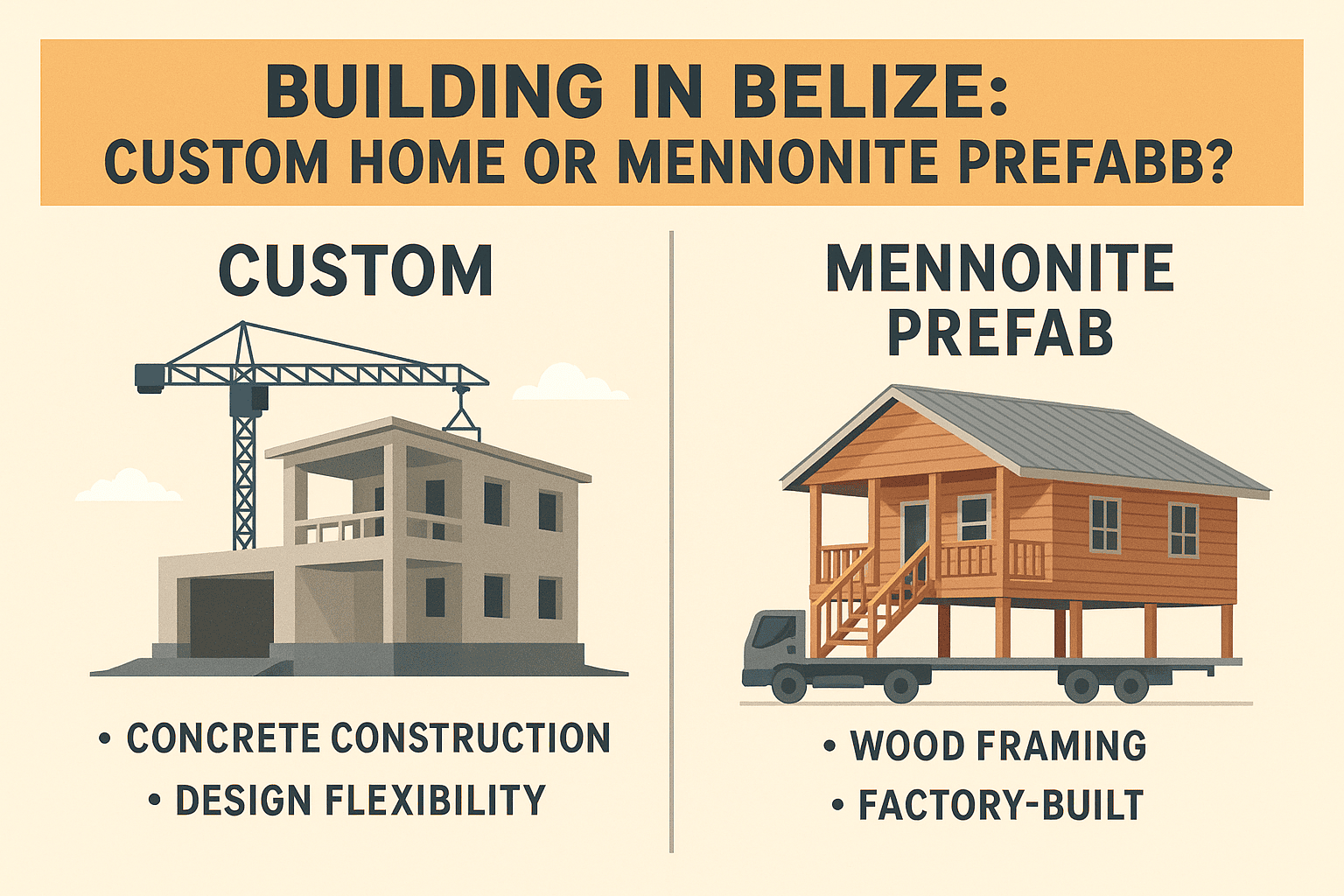
Both paths can bring you success and enjoyment on Ambergris Caye. What you choose depends on speed, budget, flexibility, and the level of build complexity you want Secret Beach Homes’ construction management service to handle for you.
Key takeaways:
- Prefab = speed + lower shell cost. Mennonite houses are factory‑built in Spanish Lookout and delivered to site—including the cayes—with standard hurricane straps and hardwood framing. Typical module size is up to 20′ × 40′ per section, but can be combined for additional square footage.
- Custom = design freedom + concrete durability. Most custom island homes are poured‑in‑place concrete or masonry for storm and salt resilience. More often we are also seeing an increase in usage of ICF (insulated concrete forms) for speed and quality of concrete construction.
- Permits apply to both. Custom home or Mennonite prefab, you’ll still need to hire an architect to create and submit stamped plans, pay area‑based fees, pass inspections, and receive a Certificate of Occupancy through the Central Building Authority (CBA) and the San Pedro Building Unit.
- Costs diverge in the details. Prefab “shell” prices look low, but delivery, foundations, elevation, utilities, and interior finishes meaningfully narrow the gap with turnkey custom builds. While prefab homes can offer great affordability, your selection of finishes and customizations can significantly affect overall cost.
- Renting it out? Short‑term rentals must register with the Belize Tourism Board (BTB) and collect/remit the 9% accommodation tax. This can be a lengthy process as well, so prepare in advance so you are ready to rent soon after completing construction.
What “Mennonite prefab” really means in Belize
In Belize, “Mennonite houses” are prefabricated wooden homes built primarily in Spanish Lookout (Cayo District). Units are trucked or barged to your lot—including Secret Beach—then set on posts/piers and tied down. Plett’s Home Builders is a leading provider; modules are commonly up to 20′ × 40′ and can be combined for larger footprints. They build using local hardwoods and include hurricane straps as standard.
Reality check: A prefab “shell” is not a turnkey home. Delivery, set‑down, tie‑downs, elevation to final floor height, utility connections, cistern/septic, decks, and interior finishes are separate line items and need to be considered in the overall budget.
Custom vs. Prefab at a glance
| Factor | Mennonite prefab | Custom site‑built |
|---|---|---|
| Speed | Factory build + delivery; often 6-8 weeks from fabrication to set‑down (builder capacity + logistics). On‑island finishes add time. | Full design‑permit‑build; typically months including permit lead time and procurement. |
| Up‑front cost | Lower shell price; add barge/delivery, foundation/posts, utilities, interior finishes. | Turnkey $/ft² is higher due to concrete materials, finish quality levels, and island logistics and weather. |
| Design flexibility | Constrained by module size (20′ × 40′ per section), but sections can be joined. | Unlimited form factors; ideal for unique sites, multi‑storey layouts, and premium detailing. |
| Durability/maintenance | Hardwood framing + hurricane straps; regular coating/maintenance in marine conditions recommended. | Reinforced concrete/masonry is common on the cayes for wind/salt resilience and lower exterior upkeep. |
| Permits | Required: stamped plans, inspections, occupancy—same process as custom. | Required with Belize‑licensed architect/engineer stamps (thresholds below). |
What it really costs to build in Belize.
Prefab (Mennonite) shell snapshots
Recent public examples from Plett’s (prices shown in Belize dollars; the Belize dollar is pegged at BZ$2 = US$1):
- 20 × 40 (~800 ft²), 3‑bed/1‑bath: BZ$66,289 ⇒ ~US$33,145 (~US$41/ft²).
- 20 × 30 (~600 ft²), 2‑bed/1‑bath: ≈BZ$64,000 ⇒ ~US$32,000 (~US$53/ft²) (social post).
What a typical shell includes: floor system on 6×6 hardwood posts @ ~3′, hardwood tongue‑and‑groove floors, doors/windows, galvanized zinc roofing, basic stairs; verandas/interiors often optional. A shell does not have any finishings and is not a move-in-ready home. If you are planning to rent the home or obtain a certificate of occupancy, interior finishes will need to be added, and this is often a 100%-300+% increase over the cost of the shell.
Plan on extras: barge/delivery to Ambergris Caye, raising to 8–10′ floor height if desired, pier or post foundations, utility connections (power, water/cistern, septic), decks/railings, cabinetry, AC, and appliances. Confirm current lead times and deposits with your builder Secret Beach Homes.
Custom, site‑built (typical Ambergris Caye ranges)
Turnkey custom builds on Ambergris Caye, meaning a home that includes all finishes and would be able to obtain a certificate of occupancy and pass all BTB rental inspections is broadly in the US$240–$350/ft² range, depending on finishes, structure, and logistics (some builder guidance cites US$240–$265/ft² for standard finishes of a wood home) Concrete or ICF built homes add a 15%-30% premium or more due to the increase in materials and labor costs.
Bottom line: prefab shells can look dramatically cheaper per ft²—but once you add delivery, elevation, services, and interiors, the installed, move‑in number narrows the gap with a well‑specified custom home. Compare apples to apples on full scope.
Permits & approvals for San Pedro and Secret Beach
Who’s in charge?
The Central Building Authority (CBA) sets national standards; the San Pedro Town Building Unit handles local intake, inspections, and occupancy on Ambergris Caye. Do not attempt to build your home without a building permit, also known as a No Objection Letter. Even if you are having a Mennonite shell delivered to your location, a no-objection letter is required for a permanent structure.
What you submit (per Government of Belize):
- Stamped plans by project size:
- Under 1,000 ft²/1 storey: a technician may stamp/sign (CBA may still require pro stamps based on complexity or additional features like a pool or hot tub).
- 1,000–3,000 ft² (≤2 storeys): Belize‑licensed architect OR civil/structural engineer must stamp/sign.
- >3,000 ft² or >2 storeys / public buildings: both architect and engineer stamps.
- Plan set & documents: site and location plans; floor plans; elevations; two cross‑sections (incl. foundation); PUC‑approved electrical/plumbing schematics; structural drawings; proof of ownership; signatures on every page; 3–4 complete sets.
- Fees: Application + area‑based permit fees per the CBA schedule (e.g., posted residential schedules show BZ$50–$100 application and BZ$0.10–$0.15/ft² permit fees—confirm current). Not including the architect and engineer fees for services.
On Ambergris Caye: San Pedro’s Building Unit accepts online submissions and typically requires proof of ownership/sales agreement, property tax clearance, and relevant approvals (PUC/Public Health). They conduct pre‑construction and in‑progress inspections before issuing occupancy.
Codes & regulations you’ll design to
Belize’s framework includes the Belize Building Act (Chapter 131), the Belize Building Regulations 2022, and the 2025 prescription of the national Belize Building Code (2024). Expect wind, structural, and life‑safety criteria consistent with modern code practice.
Coastal rules to know
- The 66‑foot beach reserve (often called “Queen’s Land”) is public; respect setbacks and don’t encroach.
- Over‑water or seabed use (piers, etc.) brings additional agencies and clearances into play.
- For a non-waterfront standard lot setback requirements are 4.5′ on all sides with a 10′ setback from the road.
If you will rent nightly
You must register with the Belize Tourism Board (BTB) as a tourist accommodation and collect/remit the 9% Hotel & Tourist Accommodation Tax—even for vacation rentals. This process can take several months so start your application as soon as possible.
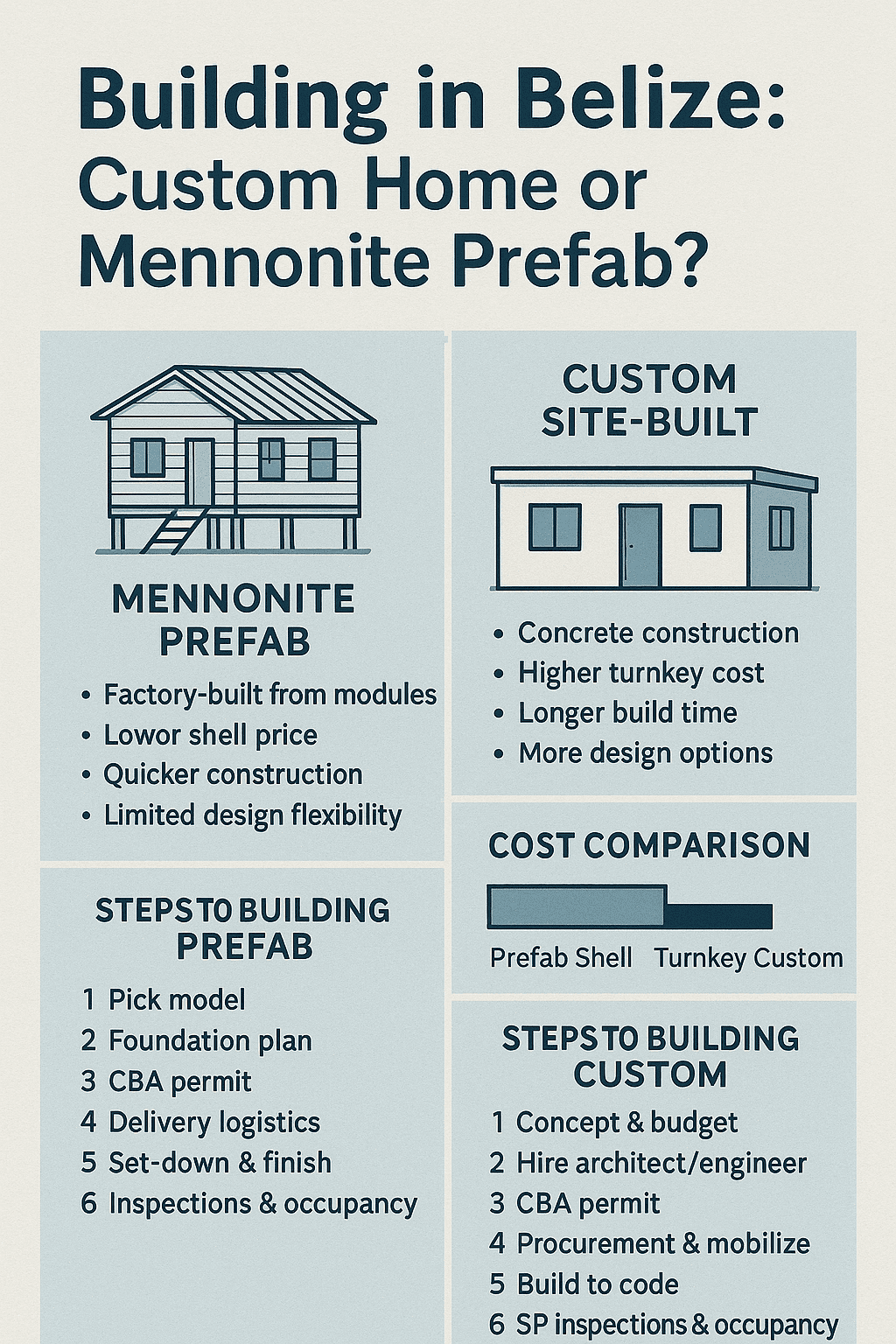
Step‑by‑step: two clean paths to a home on Secret Beach
A) Prefab path (Mennonite builder + island setup)
- Lot due diligence (survey, access, setbacks; remember the 66‑foot coastal reserve if you are on the waterfront. For all other parcels, additional setback requirements apply).
- Pick your model + options (module size, layout, verandas, insulation, target floor height—often raised).
- Foundation plan (hardwood posts or concrete piers; get the post layout to pre‑set piers). A builder like Secret Beach Homes will prepare your foundations before delivery of the home. The Mennonite company will not handle this step of the process. Be sure to get construction management services in place ahead of time for a smooth single point of contact to handle the entire process.
- CBA permit (stamped plans per thresholds above; include MEP and structural).
- Delivery logistics (Spanish Lookout → port → barge to Ambergris Caye; coordinate roll‑off to your lot). Your builder will help coordinate this.
- Set‑down & tie‑downs (raise to final height, bolt to piers/posts, weatherproofing).
- Utilities & finishes (cistern/septic/power/telecom, cabinets, AC, solar if desired).
- Inspections & occupancy certificate via the Building Unit/CBA.
B) Custom site‑built path (architect + GC)
- Concept & budget (align finish level with island‑realistic costs—don’t use mainland numbers).
- Hire a Belize‑licensed architect/engineer (mandatory above 1,000 ft²/2 storeys; smart practice on any structural build).
- CBA permit (full drawing set, structural calcs; area‑based fees).
- Procurement & mobilization (barge schedules, weather windows, long‑lead items).
- Build to code (wind/corrosion/moisture details per national code).
- San Pedro inspections & occupancy.
What to scope first
- Program: beds/baths, covered outdoor space, storage (owner’s closet), and a mechanical room sized for off‑grid gear.
- Finish tier: “rental‑ready standard,” “mid‑market,” or “premium.” (Windows/doors, cabinets, AC tonnage, and exterior cladding drive the delta.)
- Systems: solar + batteries (with generator), rainwater cistern, septic, and telecom—Secret Beach is off‑grid by design.
- Logistics: barge/crane, road access/turn radii, and a staging plan for heavy items.
Budget framework (line‑item buckets)
- Soft costs: surveys, soils (where applicable), design, engineering, permit fees, plan‐set printing.
- Structure & envelope: foundations/elevation, shell, roof, windows/doors.
- MEP: electrical (PUC‑approved design), plumbing, HVAC, solar/battery/generator.
- Interiors & site: cabinets, fixtures, appliances, railings, decks, walkways.
- Logistics & mobilization: barge/crane, on‑island transport, mobilize/demobilize.
- Contingency: island builds deserve a healthy buffer for weather and freight variability.
Reality check: The official Belize dollar is pegged at BZ$2 = US$1, which keeps conversions simple—but it doesn’t tame island logistics. Plan with that in mind, especially for barge timing and long‑lead items. (Electrical plan approval by the PUC is explicitly required in San Pedro submissions.)
Hire a Belize‑licensed architect/engineer
Mandatory above 1,000 ft²/≤2 storeys; smart practice for anything structural.
What the rules say
- < 1,000 sq ft & 1 storey: no architect/engineer stamp required if a qualified technician stamps/signs every page and accepts responsibility.
- 1,000–3,000 sq ft (≤2 storeys): stamped and signed by either a Belize‑licensed architect (APAB) or civil/structural engineer (APEB).
- > 3,000 sq ft or > 2 storeys / any public building: both architect and engineer stamps required. GOB Online
Due‑diligence checklist
- Verify APAB/APEB standing and Belize licensure; confirm who is professional of record.
- Confirm your electrical designer will obtain PUC approval (San Pedro requires it).
- Ask for a deliverables schedule: schematic → DD → CD, plus permit responses and site visits.
Pro tip: If your design includes a cistern, San Pedro calls out registered civil/structural engineering approval—don’t let that hold you up at submission.
CBA permit
Full drawing set, structural calcs where applicable; fees are area‑based.
Your submission pack (core items)
Per the Government of Belize’s official guidance:
- Site plan (boundaries, access, utilities, septic/soak‑away).
- Location plan (how to reach the site).
- Floor plans for each level + foundation/basement, elevations, and two cross‑sections (including foundation and materials).
- Electrical schematic (PUC‑approved) and plumbing schematic (inc. septic).
- Structural drawings (where applicable) and specs of water‑retaining structures.
- Proof of ownership/authority to build.
- 3 complete sets (4 recommended); one set must stay on site during construction.
- Each page stamped and signed by the professional(s) of record (or technician for the sub‑1,000 sq ft exception).
- Application & permit fees charged by area per CBA schedules. GOB Online
Where you file on Ambergris Caye
The San Pedro Town Council – Building Unit handles intake, inspections, and occupancy locally under the CBA. Their checklist mirrors the national requirements and explicitly lists PUC electrical approval, property‑tax clearance, and Health Department sign‑off. sanpedrotowncouncil.org
Procurement & mobilization
Barge schedules, weather windows, and long‑lead items decide your calendar.
Long‑lead culprits (order early)
- Windows/doors (salt‑rated hardware), specialty roofing, solar inverters/batteries, high‑SEER mini‑splits, stainless/galvanized connectors.
Logistics that matter
- Barge is standard for the Cayes; plan crane/roll‑off and on‑island haulage to the lot. Coordinate module sizes/weights and turning radii with your transporter. (Even prefab homes are routinely shipped by barge to San Pedro.) Pletts Home Builders
- Belize has a professional logistics ecosystem (freight, brokerage, barge services); book slots in advance and build in slack for sea state. BELTRAIDE
Mobilization checklist
- Permits in hand; stamped drawings on site.
- Confirm insurance and site safety plan with your GC.
- Confirm barge/crane booking, equipment access routes, and staging.
- Finalize draw schedule tied to milestones (foundation, dry‑in, MEP rough‑in, substantial completion).
Build to code
Wind, corrosion, moisture—design to the national code now in force.
Belize has prescribed a national building code—the 2024 Belize Building Code—by regulation in 2025, aligning standards with IBC‑style performance for structural/wind, fire/life‑safety, and building systems. Your design, materials, and field work must comply. National Assembly+2Attorney General’s Ministry of Belize+2
Island‑smart details your team should own
- Continuous load path & uplift restraint (engineered anchors/tie‑downs).
- Corrosion resistance in a salt environment: hot‑dip galvanized or stainless fasteners/connectors; coastal‑rated coatings.
- Moisture management: roof underlayment, flashings, ventilation, and AC condensate routing that won’t eat your structure.
- Electrical installed to the PUC‑approved design and inspected. sanpedrotowncouncil.org
Note: The Belize Building (Amendment) Act, 2025 also enables a temporary occupancy certificate under prescribed conditions—useful for staged move‑ins when the law and inspectors allow. Attorney General’s Ministry of Belize
San Pedro inspections & occupancy
Local checks, documented close‑out, and the certificate that lets you move in.
Expect checkpoints (typical)
- Pre‑foundation (layout/elevation), structural milestones, and MEP rough‑ins, followed by final and occupancy review.
- San Pedro’s Building Unit publishes the forms you’ll need, including Application for Permit to Use and Occupy. Keep an approved plan set on site—they require it. sanpedrotowncouncil.org
Close‑out package
- Final inspection sign‑offs, any utility/health clearances, and the certificate of occupancy (or temporary occupancy where permitted by law). Attorney General’s Ministry of Belize
Want it turnkey without the tail‑chasing?
Secret Beach Homes can run the whole sequence—budgeting, permits, logistics, inspections—and price Prefab vs. Custom side‑by‑side for your lot. We’ll bring the APAB/APEB team, coordinate PUC approvals, and keep your barge calendar honest.
When to pick which
Choose Prefab if you want:
- Speed to occupancy and a budget‑first home.
- Compact cabanas or a multi‑unit rental cluster where time‑to‑cashflow matters.
Choose Custom if you want:
- Long‑term, concrete durability; larger spans/heights; distinctive architecture.
- High‑end finishes, multi‑story layouts, and integrated pools/roof decks/solar.
FAQs
Do prefab homes still need a permit?
Yes. Any new build or addition requires CBA approval, stamped plans per size thresholds, inspections, and an occupancy certificate.
Can Mennonite houses handle storms?
Plett’s installs hurricane straps on their homes; long‑term performance depends on proper foundations/tie‑downs and maintenance in a marine environment. Your engineer should validate anchoring for site‑specific wind loads.
How big can a prefab be?
Up to 20′ × 40′ per section; larger footprints are created by joining sections or adding site‑built components.
What if I plan to rent nightly on Airbnb/VRBO?
Register with the BTB as a tourist accommodation and remit the 9% Hotel & Tourist Accommodation Tax.
Sources
- Government of Belize (GOB Online): plan‑stamping thresholds, plan‑set contents, submission and approvals.
- San Pedro Building Unit: local submissions/inspections for Ambergris Caye; online application.
- National code & regs: Building Act (Chap. 131); 2022 Regulations; 2025 prescription of the Belize Building Code (2024).
- Prefab detail: Plett’s Home Builders—materials, shell inclusions, sizes, cayes delivery.
- Costs: Secret Beach Homes guidance for Ambergris Caye ($/ft²) and Belize.com mainland benchmarks.
- Currency peg: BZ$ is pegged at 2:1 to US$.
- Coastal rules: 66‑foot reserve and coastal guidelines; additional approvals for over‑water structures.
Ready to compare options—side by side?
Secret Beach Homes will price Prefab vs. Custom for your exact lot (same bed/bath and finishes), coordinate permitting with the San Pedro Building Unit/CBA, and manage delivery or full site construction all the way to keys—or keys + a booking calendar.
→ Request your two‑option estimate today from Secret Beach Homes.