

What lasts, what’s fastest, and what fits your budget—so your house stands tall and dry for decades.
The 30‑second take
- Prefab Mennonite homes: Wood posts are standard and usually the fastest, most economical way to get elevated. Just make sure the footers are drilled to competent limestone (bedrock) and that termite and hurricane hardware specs are handled correctly.
- Custom or larger/heavier homes: Reinforced concrete posts (piers/columns) are the long‑haul choice—stiffer, higher‑capacity, and lower‑maintenance, especially for multi‑story or concrete/CMU builds. Plan for a longer timeline because concrete needs time to gain design strength.
Why elevation and “to‑bedrock” matter here
Belize’s coast and cayes face hurricanes, storm surge, waves, and flood. Best‑practice coastal design elevates homes on open foundations (piles/posts/columns) so water and debris can pass underneath—and ties the entire structure together with a continuous load path.
On Ambergris Caye, the subsurface is largely karsted Pleistocene limestone—shallow in many places—so drilling to competent bedrock (or otherwise to competent bearing) is often feasible and preferred for stability. This applies to Secret Beach Home Building as well.
Option A: Hardwood / Timber Posts (typical for prefab Mennonite homes)
What they are
Pressure‑treated or naturally durable hardwood posts set on footers drilled to competent bearing (ideally bedrock), then strapped/bolted to the elevated floor system. Belize’s Mennonite prefab builders commonly spec hardwood posts; many will also set on pre‑built concrete posts if you provide a post plan in advance.
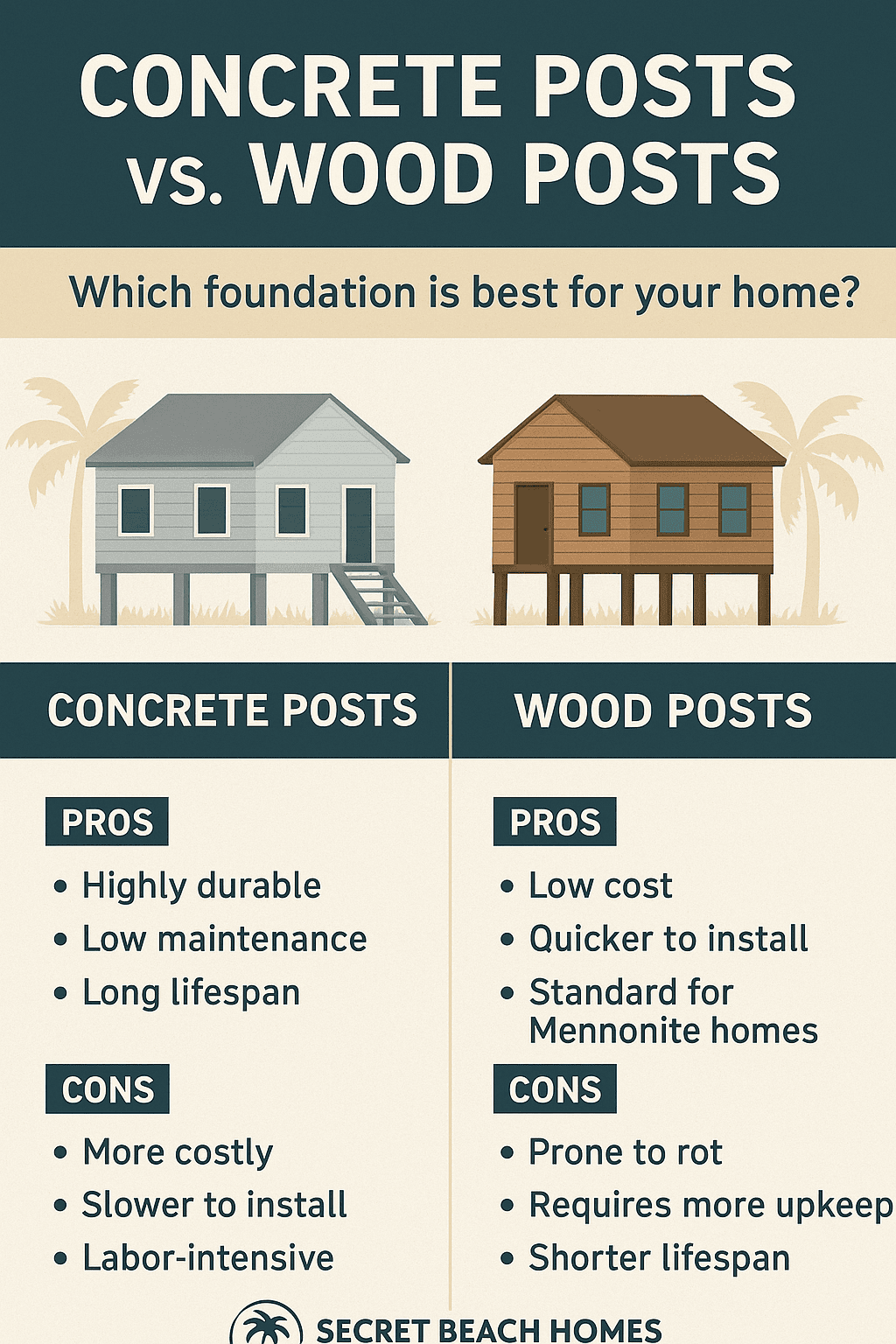
Pros
- Fastest install. No curing wait—your prefab can set as soon as posts are in and verified. (Concrete needs days to gain strength; wood doesn’t.)
- Lower upfront cost on most small–mid projects (less rebar, cement, formwork, and equipment).
- Light equipment, light logistics. Easier on remote or sandy sites.
- Resilient “give.” Timber can be forgiving under dynamic wind loads when detailed well.
Cons
- Termites & decay risk if detailing or treatment is lax. Use properly treated wood, avoid direct wood‑to‑soil contact, and field‑treat all cut ends per AWPA (a step many skip). Plan periodic inspections.
- Corrosion at connectors near salt air if you don’t spec the right hardware. In coastal zones, favor 316 stainless over standard galvanized for hurricane ties, bolts, and screws.
- Lower stiffness & capacity than reinforced concrete for big spans, heavy loads, or taller homes.
- Service life depends on species, treatment, detailing, and maintenance discipline.
Best fit
- 1‑story prefab Mennonite homes; quick timelines; tight logistics; lighter superstructures—with the non‑negotiable of properly engineered footers to competent bearing (ideally bedrock) plus termite/corrosion detailing.
Option B: Reinforced Concrete Posts / Piers / Columns
What they are
Cast‑in‑place concrete posts on drilled footers or piles with rebar cages, designed for gravity, wind, flood, and lateral loads.
Pros
- High capacity & low deflection. Ideal for larger/heavier homes, multi‑story, roof decks, or CMU/concrete superstructures.
- Termite‑proof structure (still maintain wood members above).
- Durability when detailed for a marine environment (cover, mix, and corrosion‑resistant hardware).
- Lower maintenance over long horizons.
Cons
- Slower schedule due to forming, inspection, and curing. Expect roughly 7 days to reach a significant fraction of strength and design checks typically at 28 days—your engineer will call the load‑in timing.
- Higher upfront cost (cement, rebar, skilled labor, formwork, and logistics).
- Marine corrosion can attack embedded steel if cover/mix and details are poor—use rigorous specs and stainless for exposed connectors/hardware.
Best fit
- Custom villas; two‑story or heavy builds; sites with higher surge/wave exposure; owners prioritizing stiffness, longevity, and lower maintenance.
Compare at a glance
| Factor | Hardwood / Timber Posts | Reinforced Concrete Posts |
|---|---|---|
| Upfront cost | Usually lower | Usually higher |
| Speed | Fastest (no cure) | Slower (forming + cure) |
| Durability | Good with treatment + maintenance; vulnerable to termites/rot if neglected | Excellent when detailed for coastal exposure; immune to termites |
| Capacity / Stiffness | Moderate | High (better for large/heavy/tall homes) |
| Hurricane / Flood | Works when engineered, elevated, and strapped; hardware must resist corrosion | Excellent when engineered; standard for higher exposures and larger masses |
| Maintenance | Periodic inspections; retreat cut ends; tighten/replace corroded hardware | Lower routine maintenance; inspect for cracking/spalling/corrosion |
| Environmental exposure | Hardware is the weak link—spec 316 SS near salt air | Rebar cover/mix & external hardware must be specified for marine |
What is best for you?
Choose Wood Posts if you want:
- The fastest set for a prefab Mennonite home.
- The lowest upfront numbers today.
- A simple site with shallow limestone and low–moderate loads—and you commit to proper treatment, bedrock footers, and stainless/galvanized detailing.
Choose Concrete Posts if you want:
- Stiffness & capacity for bigger spans, a second story, roof decks, or concrete/CMU walls.
- Longevity with minimal maintenance.
- A site with higher surge/wave exposure where open, deep foundations shine.
Wood or Concrete, these are the Non‑negotiables
- Engineer the foundation for coastal loads and keep the space below elevated floors open (no breakaway obstructions) in flood‑prone zones. That’s core FEMA coastal guidance. (FEMA)
- Drill footers to competent bearing—on Ambergris Caye that often means limestone bedrock near the surface—then tie posts properly to the structure. (Ambergris Caye)
- Termite strategy: treated wood, no wood‑to‑soil contact, and field‑treat every cut/bolt hole/end cut. Plan inspections.
- Corrosion strategy: in salt air, specify 316 stainless (or equivalent) for exposed connectors, straps, and fasteners; use hot‑dip galvanized where appropriate inland. (Simpson Strong-Tie)
- Concrete cure & QA: don’t rush the schedule—plan staging, protection, and cure time per your engineer’s criteria (7‑day checks; 28‑day design strength benchmarks).
Where prefab Mennonite builds fit
For many buyers, a Mennonite prefab set on properly founded hardwood posts is the sweet spot on speed and budget. Confirm in writing how your builder will handle footers (to competent bearing/bedrock), post layout, and hardware, and know that many prefab builders are happy to set on pre‑built concrete posts if you provide the pier plan first. But make sure your construction manager, like Secret Beach Homes, is involved in the process to ensure high-quality site work.
How Secret Beach Homes keeps you out of trouble
From site prep to final set, the difference is in the sequencing and QA:
- Site & soils check: probe to verify competent bearing (often limestone) and set finished‑floor elevation for surge and drainage.
- Clearing & backfill: remove organics, place and compact suitable fill as needed to control ponding.
- Drill footers to bedrock/competent bearing and install rebar cages where specified. (Belize’s 2024 Building Code recognizes deep foundations developing capacity in soil and/or bedrock—designs follow the engineer of record.)
- Build the foundation you chose:
- Concrete posts: form, pour, cure, and verify strength before load‑in. (Giatec Scientific Inc.)
- Wood posts: set to layout, plumb and brace, and bolt/strap to the beam with the correct stainless/galvanized hardware.
- Continuous load path: hurricane ties/straps from foundation → beams → floor → walls → roof, per coastal guidance. (FEMA)
- Final QA & set: verify elevations, fasteners, and treatments; coordinate the prefab set or frame‑up.
Bottom line
- Time & budget first? Hardwood posts for prefab—but only with bedrock footers, termite detailing, and corrosion‑resistant hardware.
- Scale, stiffness, longevity first? Concrete posts for customs/larger homes—expect a longer schedule and higher upfront cost, rewarded with decades of low‑maintenance performance.
Secret Beach Homes will manage it end‑to‑end—clearing, backfill, drilling footers to bedrock, and building concrete posts, or coordinating with your Mennonite builder to ensure wood posts are set, anchored, and protected correctly for long‑term stability. If you’re weighing options, reach out to discuss site‑specific costs, timelines, and the right foundation for your home. Contact us here.