
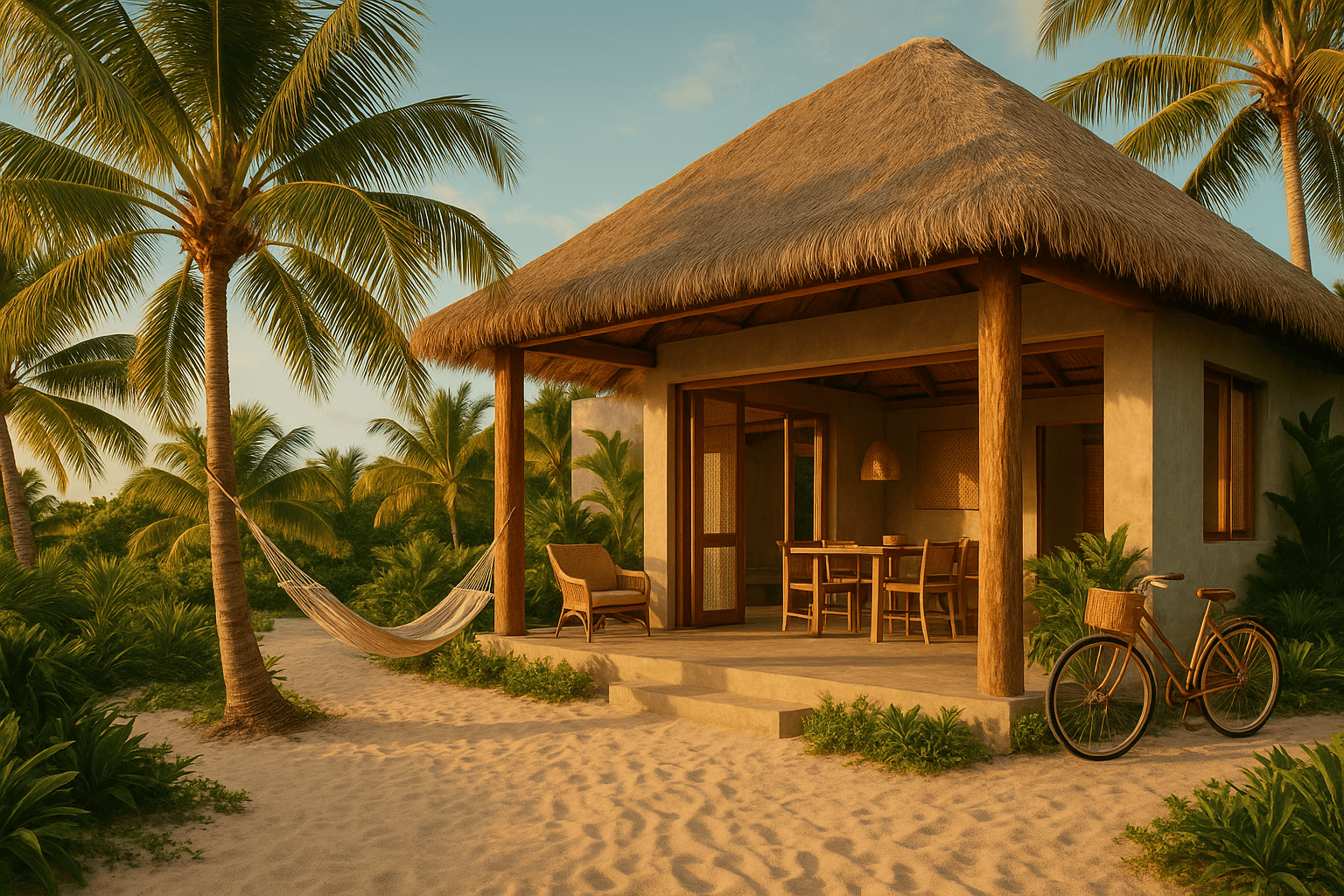
Building homes in tropical climates is challenging due to intense heat, high humidity, salt-laden air, and strong winds. Choosing the right materials can reduce maintenance, improve energy efficiency, and ensure durability. Here are six materials that excel in tropical conditions:
- Natural Stone: Heat-resistant and long-lasting options like limestone, granite, and marble keep homes cooler and withstand humidity.
- Treated Hardwood: Durable woods like mahogany and teak resist rot, insects, and moisture when treated properly.
- High-Strength Concrete (HSFC): Incorporates eco-friendly additives, resists moisture, and handles extreme heat.
- Bamboo: Fast-growing, strong, and pest-resistant, bamboo is a renewable option for construction.
- Cool Roofing: Reflective materials like coated concrete tiles and clay reduce indoor heat and cut cooling costs.
- Cellular Lightweight Concrete (CLWC): Lightweight, insulating, and fire-resistant, it’s ideal for walls and panels.
These materials combine durability with energy efficiency, making them perfect for building homes in tropical climates like Secret Beach.
Quick Comparison:
| Material | Key Features | Best Applications |
|---|---|---|
| Natural Stone | Heat-resistant, durable | Floors, walls, countertops |
| Treated Hardwood | Moisture and insect-resistant | Decks, furniture, structures |
| High-Strength Concrete | Eco-friendly, moisture-resistant | Foundations, walls |
| Bamboo | Strong, renewable, pest-resistant | Frames, scaffolding, flooring |
| Cool Roofing | Reflects heat, reduces cooling cost | Roofs |
| Cellular Lightweight Concrete | Lightweight, insulating | Walls, panels, insulation layers |
These materials address tropical climate challenges while supporting eco-friendly construction.
Six of the Best Building Materials for Humid Climates 2025
Here are the top 6 types of building materials you might want to consider when building a home or vacation property in the Tropics.
1. Natural Stone: Heat-Resistant and Long-Lasting
Natural stone is a solid choice for tropical climates, offering durability and the ability to handle both high heat and humidity effectively.
Different types of natural stone bring unique benefits:
Limestone is an excellent option for hot climates. > “Limestone is one of the best stones for hot weather due to its natural ability to stay cool even under intense sunlight”, says Rockstone [2]. Its porous structure and light color help reflect sunlight, keeping indoor spaces cooler.
Granite stands out for its toughness. > “Granite is one of the most durable and heat-resistant stones available”, according to Rockstone [2]. This makes it perfect for high-traffic areas like kitchen countertops and floors.
Marble combines functionality with elegance. > “Marble remains cool to the touch, even in direct sunlight, making it a great choice for upscale homes, hotels, and commercial buildings in hot regions” [2]. Its cooling properties add to its appeal for both residential and commercial projects.
Other benefits of natural stone include:
- Slate roofing can last up to 100 years [3].
- Slate has water absorption rates as low as 0.4% [3].
- Natural resistance to rot, insects, and fire [3].
| Stone Type | Best Applications | Key Benefits |
|---|---|---|
| Limestone | Flooring, facades | Stays cool, reflects sunlight |
| Granite | Countertops, flooring | Extremely durable, heat-resistant |
| Marble | Interior surfaces | Cool to touch, reflects heat |
| Travertine | Outdoor spaces, pools | Slip-resistant, stays cool |
| Sandstone | Exterior walls, walkways | Heat-resistant, natural look |
Tip: When choosing a stone, keep factors like water absorption, density, and wear resistance in mind for the best results [3].
2. Treated Hardwood: Weather-Ready Timber
Treated hardwood plays a key role in tropical construction, blending toughness with natural elegance. When properly treated, hardwood can handle the challenges of intense sunlight, heavy humidity, and frequent rainfall.
Premium tropical hardwoods like Mahogany and Cedar are standout options for these demanding conditions. For example, Cedro heartwood is prized for its insect-repelling, aromatic resin, making it a popular choice in Spanish-cedar applications [4]. The 2024 Belize Sustainable Forestry Program has boosted certified sustainable hardwood production by 15%, ensuring a steady supply of high-quality materials while safeguarding local forests [4].
Durability and Lifespan
Not all hardwoods are created equal when it comes to tropical environments. Here’s a breakdown of their durability and other key features:
| Wood Type | Expected Lifespan | Hardness Rating (lb) | Key Benefits |
|---|---|---|---|
| Ipe | 70 years | 3,680 | Outstanding resistance to rot and insects |
| Teak | 50+ years | 1,070 | Naturally water-resistant |
| Mahogany | 30+ years | 1,600 | Maintains shape in varying conditions |
| Garapa | 30 years | 1,650 | Budget-friendly option with solid durability |
Maintenance Tips and Installation Advice
To get the most out of hardwood in tropical settings, follow these steps:
- Use protective sealants every 2–3 years.
- Ensure proper drainage and opt for corrosion-resistant fasteners.
- Keep the wood elevated to avoid direct ground contact.
- Prevent mold by providing adequate ventilation.
For projects near the coast, apply specialized sealants and maintain the wood regularly to protect against salt spray. Additionally, locally sourced hardwoods like Banak, Barba Jolote, and Billy Webb offer eco-friendly alternatives [4].
Pro tip: When selecting hardwood for tropical construction, focus on species with a proven history in similar climates. Always verify that the wood comes from certified sustainable sources.
Treated hardwood stands up to the elements, offering both durability and aesthetic appeal. Prefab homes are an affordable option for having a wood home built and set-up in Secret Beach. Did you know you can design your prefab home right online using this design tool?
Up next, we’ll dive into high-strength concrete designed specifically for tropical conditions.
3. High-Strength Concrete: Built for the Tropics
High-strength concrete (HSFC) stands out as a durable option for tropical climates. It combines excellent performance with materials that are more environmentally friendly, making it well-suited for handling extreme heat and humidity.
Composition and Strength
Modern HSFC incorporates supplementary cementitious materials (SCMs) such as fly ash, silica fume, and ground slag, replacing up to 70% of traditional Portland cement. These additives improve both workability and strength while also reducing the material’s environmental footprint. With the addition of chemical and pozzolanic admixtures and a low water-to-binder ratio, HSFC can reach compressive strengths of up to 10,000 psi (70 MPa) within just 28 days [5].
| Component | Purpose | Environmental Benefit |
|---|---|---|
| Fly Ash | Improves workability | Reduces cement usage |
| Silica Fume | Enhances strength | Decreases permeability |
| Ground Slag | Boosts durability | Lowers carbon emissions |
Climate-Specific Advantages
HSFC offers several benefits tailored to tropical conditions. It resists moisture penetration, retains its strength even in high temperatures, increases compressive strength, and minimizes free shrinkage [5]. These features make it a top choice for structural projects in hot and humid environments.
Practical Applications
HSFC is commonly used for foundations, load-bearing walls, and other critical structural elements in coastal and tropical homes. Proper curing and maintaining the right water-to-binder ratio are essential to prevent cracking and achieve maximum strength.
Its effectiveness in extreme conditions has been proven in projects like the Burj Khalifa in Dubai, UAE – one of the hottest regions on the planet. This iconic structure highlights HSFC’s ability to withstand intense thermal stress, making it an ideal material for resilient construction in tropical climates [5].
4. Bamboo: Fast-Growing and Strong
Bamboo stands out as an ideal material for construction in tropical climates, offering a combination of fast growth and impressive strength. Its use in modern construction continues to rise, especially in warm and humid regions. Although it’s not widely used in Belize.
Growth and Renewability
Certain bamboo species can grow up to 35 inches in a single day and reach maturity in just seven years. Compare that to the 30–50 years it takes for traditional hardwoods to mature, and it’s easy to see why bamboo is a standout choice for sustainable projects [6].
Strength and Durability
Bamboo’s lightweight nature doesn’t compromise its strength. Here’s how it performs:
| Property | Performance Details |
|---|---|
| Tensile Strength | Stronger than many steel alloys [7] |
| Compressive Strength | Outperforms several concrete types [7] |
| Hardness | Scores 1,380 on the Janka scale (harder than walnut, oak, and ash) [6] |
| Regrowth Time | Fully regenerates in just six months [7] |
Benefits in Tropical Climates
Bamboo thrives in tropical settings, offering unique advantages:
- Its high silica content naturally deters pests.
- A robust root system helps manage moisture effectively.
- Bamboo structures have shown resilience during natural disasters, like the 1992 Costa Rica earthquake, where bamboo homes withstood a 7.5 magnitude quake [6] [7].
Environmental Contributions
Bamboo plays a significant role in improving air quality. Each hectare absorbs about 26,000 pounds of carbon dioxide annually while producing 35% more oxygen than typical trees [6].
Real-World Uses
While not common in Belize, bamboo is widely used in construction across the globe:
- Hong Kong: Builders use bamboo scaffolding as a practical and cost-effective alternative to metal [6].
- India: Engineers reinforce roadways with bamboo for added strength [6].
- China: Bamboo bridges can support trucks weighing up to 16 tons [6].
Its natural durability also reduces the need for chemical treatments like varnishes or sealants, cutting down on both maintenance costs and environmental harm [6].
Next, we’ll dive into another material designed for tropical construction challenges.
5. Cool Roofing: Heat-Reflecting Materials
Roofing plays a key role in maintaining indoor comfort in tropical climates. Beyond structural materials, cool roofing provides extra energy savings by managing heat more effectively.
How Cool Roofs Work
Cool roofs rely on two main properties to handle heat:
| Property | Function | Impact |
|---|---|---|
| Solar Reflectance (SR) | Reflects sunlight away from the building | Lowers the amount of heat absorbed |
| Thermal Emittance (TE) | Releases absorbed heat efficiently | Prevents heat from building up |
This technology helps keep indoor temperatures around 82°F, while traditional roofs can reach over 150°F [10].
Material Options
- Modified Bitumen with Light Coating
Costs range from $4–$8 per square foot when paired with a reflective coating [8]. - Advanced Concrete Tiles
Coated concrete tiles, priced at $13–$23 per square foot, are durable and excel at managing heat. For instance, a cool chocolate brown tile with a solar reflectance of 0.41 can keep attic temperatures 5–9°F cooler compared to standard roofs [8] [10]. - Clay and Terracotta
These traditional materials, costing $5–$20 per square foot, naturally offer cooling properties along with durability [8].
Energy and Cost Benefits
“Cool roofs work best (save more energy) in hot sunny climates, like the Southern U.S., on buildings with low levels of roof insulation.” – ENERGY STAR [9]
Cool roofs can cut cooling costs by 10–15%, reduce energy consumption by up to 70%, and extend the roof’s lifespan by minimizing thermal stress [8] [9] [10].
Installation Considerations
To get the most out of a cool roof:
- Perform annual maintenance to maintain reflectance levels.
- Ensure proper sealing, ventilation, and choose the optimal roof angle.
- Hire professional installers for the best results.
Cool roofs also contribute to broader benefits, like reducing the urban heat island effect and lowering strain on the electrical grid during peak cooling times [9]. In tropical climates, roofs can account for up to 70% of total heat gain [10].
Up next, we’ll dive into cellular lightweight concrete, the final material for tropical construction.
6. Cellular Lightweight Concrete: Strong Yet Light
Cellular Lightweight Concrete (CLWC) is a great addition to tropical construction, combining structural efficiency with thermal insulation. Like cool roofing, it helps reduce energy use while offering durability.
CLWC is made from a cement-based slurry mixed with engineered foam, resulting in a material that’s both sturdy and lightweight – perfect for tropical climates.
Composition and Properties
What makes CLWC stand out is its adjustable density, which ranges from 300 to 1,850 kg/m³. This flexibility allows builders to tailor it for different needs [11]. Adding materials like fly ash or silica fume can further improve its performance.
| Property | Advantage | Benefit for Tropical Homes |
|---|---|---|
| Thermal Insulation | Minimizes heat transfer | Reduces cooling costs |
| Lightweight | Density from 300–1,850 kg/m³ | Lowers structural loads |
| Fire Resistance | Improves safety | Enhances overall building safety |
| Sound Absorption | Reduces noise | Creates a quieter indoor space |
Practical Applications
Because of its lightweight nature, CLWC is ideal for non-load bearing uses [11], such as:
- Interior and exterior walls
- Floor and roof panels
- Insulation layers
- Partition walls
Performance in Tropical Settings
CLWC’s cellular structure helps regulate indoor temperatures naturally, cutting down the need for air conditioning. This aligns with the eco-friendly principles we’ve discussed throughout this guide [12].
Cost and Construction Benefits
One big advantage of CLWC is that it can be made directly at the construction site. This reduces:
- Transportation expenses
- Environmental impact
- Material handling challenges
Its workability makes it easy to cut and shape, saving time and labor costs. Contractors can adjust its density to suit specific applications and load requirements [11].
When paired with other materials, CLWC rounds out an effective toolkit for sustainable construction in tropical climates.
Conclusion
The materials covered here – from natural stone to CLWC – are well-suited for building in tropical climates. They effectively handle heat, humidity, and structural challenges while minimizing their impact on the planet.
Natural stone and high-strength concrete stand out for their durability and strength. Treated hardwood and bamboo present renewable options with strong resistance to moisture. Cool roofing technology improves energy efficiency, and CLWC offers flexible solutions for heat management and structural needs.
“When considering the best building materials for a hot, humid climate, protecting against moisture and heat damage is crucial.” [1]
Traditional concrete production is responsible for around 8% of global CO2 emissions [13]. Opting for these alternative materials not only ensures sturdy tropical homes but also helps lower carbon footprints.
To achieve the best outcomes in tropical construction, keep these factors in mind:
- Proper ventilation in roof designs
- Use of corrosion-resistant fasteners
- Permeable indoor wall finishes
- Building orientation to encourage airflow
These materials tackle the unique challenges of tropical climates while supporting long-term environmental goals. Their use is a step forward in creating homes that balance durability with eco-conscious construction. Discuss options with your construction manager or contractor.
FAQs
How do materials like bamboo and treated hardwood help create eco-friendly homes in tropical climates?
Sustainable materials like bamboo and treated hardwood play a crucial role in building eco-friendly homes in tropical climates. Bamboo is a fast-growing, renewable resource that absorbs carbon dioxide at high rates, helping reduce greenhouse gases. Its durability and flexibility make it ideal for tropical settings, while its cultivation can prevent deforestation by offering a sustainable alternative to traditional timber.
Treated hardwoods, like teak and mahogany, are naturally resistant to rot, moisture, and termites, making them perfect for humid environments. Their longevity reduces the need for frequent replacements, minimizing waste and conserving resources. By using these materials, you can build homes that are not only environmentally friendly but also durable and well-suited for tropical conditions.
What are the benefits of using cool roofing in tropical homes, and how does it improve energy efficiency?
Cool roofing offers several advantages for tropical homes. By reflecting more sunlight and absorbing less heat, it helps reduce indoor temperatures, making your home more comfortable and less reliant on air conditioning. This can lead to lower energy bills and reduce strain on the electrical grid during peak demand.
Additionally, cool roofing can extend the lifespan of roof materials by minimizing heat-related wear and tear. It also contributes to reducing the urban heat island effect, helping to keep surrounding areas cooler. This makes it a smart, eco-friendly choice for sustainable homes in tropical climates.×
What makes Cellular Lightweight Concrete (CLWC) a great choice for tropical homes?
Cellular Lightweight Concrete (CLWC) is an excellent option for tropical homes due to its ability to enhance both structural integrity and thermal insulation. Its lightweight composition reduces heat transfer, helping to keep interiors cooler in hot climates. This makes it ideal for maintaining comfortable indoor temperatures without relying heavily on air conditioning.
Additionally, CLWC is highly durable, offering resistance to moisture, fire, and pests – key concerns in tropical regions. Its soundproofing qualities also contribute to a quieter and more comfortable living environment. These features make it a sustainable and practical building material for homes in tropical areas.
Book a call with us to learn more about building your ultimate vacation or retirement home in Secret Beach, Belize.